Written by Dr Thomas Fauvel and Florine Verhaeghe, l'Office français de la biodiversité.
For two weeks this summer we welcomed Dr Richard Lilley, or RJ as he is better known, from our Interreg North-West Europe REBORN Lead Partner, the Rijksuniversitet Groningen, to Le Parc naturel marin du Bassin d'Arcachon (PNMBA) to collaborate and engage in knowledge exchange.
An introduction to the PNMBA
The PNMBA is a marine protected area that has the mission of addressing three fundamental objectives: 1.) Preserve natural and cultural resources, 2.) Enhance knowledge in the marine environment, and 3.) Promote the sustainable development of activities related to the sea. The area is governed by a local management board that relies on a team of agents and technical and financial resources allocated by the Office Français de la Biodiversité (OFB).
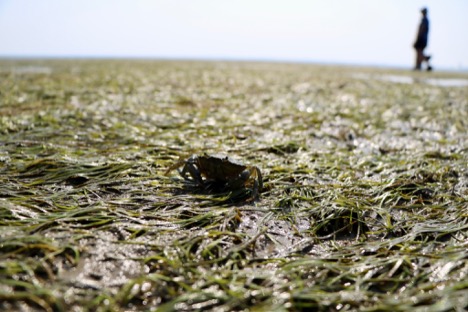
Oysters, seagrass meadows and saltmarshes are cornerstones of the marine ecosystem of the Bay of Arcachon and one of the main objectives of PNMBA is the protection and the restoration of its seagrass to the extent and functionalities preceding their regression. In 1989, the seagrass mapping work of Isabelle Auby (PhD thesis here) estimated that within the Bassin d’Arcachon, the surface area of Zostera noltii seagrass was 6846ha (found mainly on the tidal flats), and the surface area of Zostera marina seagrass 381ha (found mainly within the tidal channels).
We know today that both Zostera sp. are
dynamic, and that they can respond seasonally (both negatively and positively)
to the prevailing weather and local environmental conditions. However what we
all recognise is that this 1989 reference point (or operating baseline)
revealed over 7000ha of mixed seagrass meadows within the marine park, making
the Bassin d’Arcachon one of the largest (if not the largest) intertidal
seagrass ecosystems in Europe!
In the early 2000s Bassin d’Arcachon experienced a huge regression of seagrass,
with just 4569ha of Zostera noltii and 104ha of Zostera marina recorded
by 2008 and with severe fragmentation (Plus et al, 2010). This decline was likely
due to a number of factors, but one of those identified was a spike in
contaminants in the water column combined with severe heat waves.
However, since the creation of the PNMBA in 2014, a great deal of work has been done both by the marine park and our partners to reduce the environmental pressures on the marine ecosystems. Recent Water Framework Directive (WFD) mapping (Zostera marina in 2024) show that these ongoing ‘passive’ restoration efforts are working, with recent mapping by Ifremer Station d'Arcachon showing a positive trajectory of recovery for Zostera marina, with the surface area expanding from 56.2ha in 2016 to 80.1ha in 2024). Ifremer’s WFD mapping for Zostera noltii will take place in September 2026.
Seagrass seed collection: 6th edition of the 'Chantiers Participatifs'
Within “REBORN”, the PNMBA is particularly interested in the community-led dimensions of seagrass restoration which we are keen to continue to see being co-developed throughout the project within the Bay of Arcachon. Empowering a community-led approach and in-situ monitoring to support coastal seascape management and restoration is a priority for the PNMBA, and we have been running our own Chantier participatifs every year since 2021 to collect Zostera noltii seagrass seeds from the Île aux oiseaux. However, over the past two years these Chantier participatifs have been heavily oversubscribed and so we are looking to develop other opportunities for the public to participate in our restoration programme.
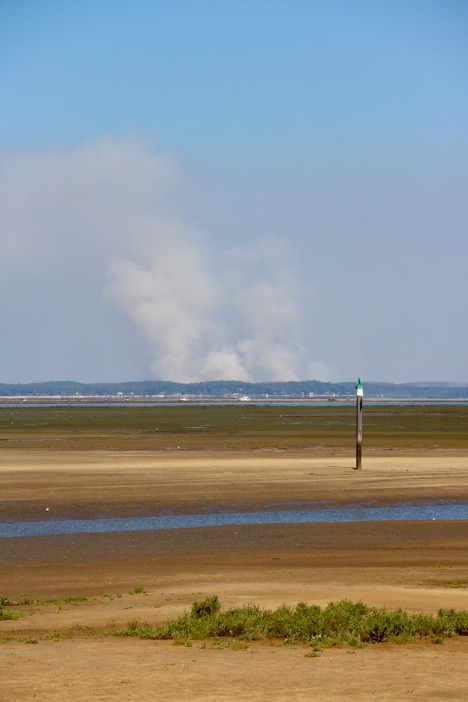
RJ has a strong background in fostering public involvement and civic engagement in marine restoration programmes and so we were really looking forward to running two pilot “Chantier participatifs” (community volunteering projects), one for the communities of the North, and one for the communities of the South of Bassin d’Arcachon respectively. However, around midday on the 22nd July, a fire broke out near Saumos just to the north of the Bassin d’Archacon. Over 11 days around 42,000 hectares of pine forest burned with nearly 220,000 people evacuated.
Plan B
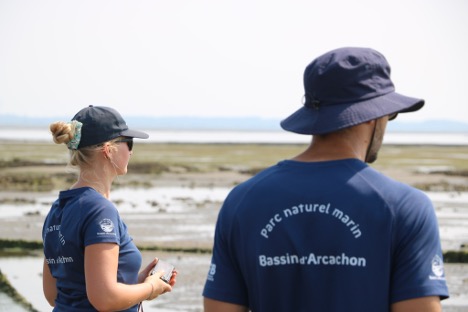
With our REBORN Chantier participatifs postponed for now, we pivoted to large-scale monitoring of our restoration sites “Gaillard” and “Salines” and several of our numerous transplant ‘test stations’ (166 in total). These stations were set up in 2025 to identify new locations around the Bassin d’Arcachon where transplantation of seagrass was likely to be successful, but also to find potential restoration sites local to those communities who have shown interest in participating in seagrass restoration efforts. As such, we also undertook monitoring of ‘test stations’ near the town of Le Teich in the south-east of the Bassin d’Arcachon and near Arès in the north.
Successes and Challenges
Overall, our monitoring revealed a mixed picture, but with a lot of cause for optimism. We are seeing some substantial seagrass expansion at “Gaillard”, and both the transplanted seagrass and the seagrass that has grown from seeding at “Salines” in 2023 is continuing to grow and expand. However, despite these localised successes, we are seeing an expansion of the invasive mussel (Arcuatula senhousia) first recorded in the bay in 2002, across the Bassin d’Arcachon. Additionally, throughout the two previous summers (2025 and 2026) we have witnessed significant areas of algal mat, which can, if present for long periods, smother the seagrass. We know that progress in restoration is never linear, but we are all looking forward to seeing if Zostera noltii is following Zostera marina in showing early signs of recovery.
REBORN Partner Meeting Planning
An additional benefit of this time together has been an opportunity to finalise the planning and logistics for the next REBORN Partner Meeting in October. As a REBORN lighthouse site, we are really looking forward to sharing our experiences with our colleagues from North-West Europe, and the full range of activities that we are undertaking with our partners across the territory as part of the PNMBAs mission to restore the Arcachon Bay’s seagrass meadows.